Self-Tanner for Beginners: A Streak-Free First Application
Almost every self-tan disaster comes from skipping the same three prep steps. A calm, mitt-in-hand walkthrough for a believable first glow.
Every summer, the same group chat lights up around June: someone is going on vacation, someone else has a wedding, and at least one person is staring at a bottle of self-tanner like it might detonate. The fear is understandable — everyone has seen the orange ankles, the zebra arms, the palms the color of a traffic cone. But nearly every famous self-tan disaster comes from skipping the same three preparation steps, not from a bad product.
Self-tanner is genuinely beginner-friendly in 2026. Gradual formulas forgive almost everything, express mousses rinse off in hours, and the color itself is more neutral-toned than the carrot era. Your first application just needs a plan: prep the day before, apply with a mitt in sections, and give it time to develop before you judge it.
The short version
Choose your format by your confidence level. True first-timers should start with Jergens Natural Glow Daily Moisturizer, a gradual lotion that builds color over days and is nearly impossible to mess up. When you're ready for a real, visible tan from one application, Bondi Sands Self Tanning Foam is the forgiving classic with a guide color so you can see where you've been. St. Tropez Self Tan Express Bronzing Mousse is the one for the impatient — rinse in one to three hours depending on how deep you want to go.
- Jergens Natural Glow Daily Moisturizer — best true-beginner gradual tanner
- Bondi Sands Self Tanning Foam — best first "real" mousse
- St. Tropez Self Tan Express Bronzing Mousse — best when you can't wait overnight
What to look for
The active ingredient is the same everywhere. DHA (dihydroxyacetone) reacts with the surface layer of your skin to create the tan color; brand differences are about tone, format, and application forgiveness, not magic. Look for formulas that mention a natural or olive-toned result if orange is your fear — modern formulas are specifically built to avoid it.
Guide color matters for beginners. Mousses with a tinted guide show you exactly where product has landed, preventing the missed-strip patches that plague clear formulas. Gradual lotions have no guide color but build so slowly that mistakes even out on their own.
Shade depth should match your starting point. If you're fair, start with light/medium even if you want to end up deep — you can add a second layer tomorrow. Going straight to the darkest shade is the express route to an unnatural finish.
Natural Glow Daily Moisturizer
- Low-level DHA inside a daily body moisturizer
- Color builds gradually with each application
- No guide color and no mitt required
What we like
- Nearly impossible to streak or over-apply
- Doubles as your regular lotion, so no extra routine step
Good to know
- Takes several days to reach noticeable depth
- Daily application needed to build and maintain color
Self Tanning Foam
- Tinted guide color shows exactly where you've applied
- Salon-style foam formula from an Australian tanning specialist
- Develops over several hours into an olive-toned result
What we like
- Forgiving to apply thanks to the visible guide
- Natural-looking tone that avoids the classic orange cast
Good to know
- Still requires a mitt and a full prep day for best results
- Guide color transfers to sheets if you dress too soon
Self Tan Express Bronzing Mousse
- Express development: rinse after 1, 2 or 3 hours for light, medium or deeper results
- Tinted mousse with a guide color for even application
- Part of the long-running St. Tropez salon tanning line
What we like
- Shower the same evening instead of sleeping in tanner
- Depth is adjustable by rinse time, so one bottle suits cautious beginners
Good to know
- Rinsing too early or late changes the result — timing matters
- Premium price among beginner options
A streak-free first application, step by step
Do the prep 24 hours ahead: exfoliate thoroughly (this is the step that decides everything), shave or wax, and then stop — no tanner on freshly exfoliated day-zero skin that's still reactive, or do prep in the morning and tan at night once skin has fully calmed. Right before applying, moisturize only the dry traps: elbows, knees, ankles, wrists, and between fingers. These areas grab extra color, and a thin barrier of plain lotion keeps them honest. A dab on the backs of heels too.
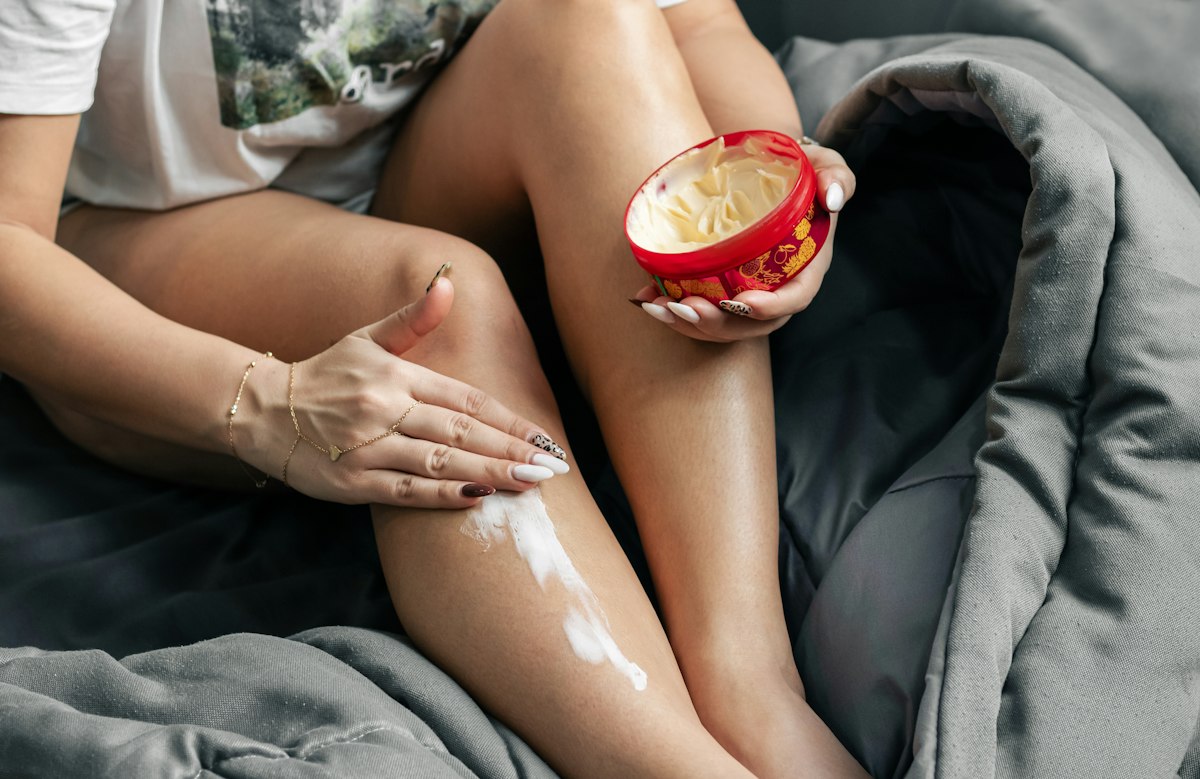
Apply with a tanning mitt, always — bare hands are how palms get stained, full stop. Work in sections (lower leg, upper leg, torso, arm) using long sweeping strokes, then a final light circular pass to blend. Use whatever is left on the mitt for feet, hands, elbows, and knees; these areas should get the residue, not a fresh pump. Face gets its own sparing pass or a face-specific product mixed with moisturizer.
Then: loose, dark clothing, no bra straps digging in, no shower, no workout, no sitting cross-legged with skin touching skin for the development window. Rinse with lukewarm water only — no soap on the first rinse — pat dry, and moisturize daily afterward to help the color fade evenly instead of in patches.
Mistakes that cause every classic disaster
Skipping exfoliation is mistake number one, and applying over yesterday's moisturizer or deodorant (which can turn armpits green with some formulas) is a close second — start with clean, product-free skin. Mistake three is panic-layering: the tan looks pale at hour two, so you add another coat, and wake up two shades deeper than intended. DHA develops over up to 24 hours; judge tomorrow, not tonight.
And the streaks on your back that you can't reach? A mitt on a long-handled applicator works, or use a gradual lotion there. Nobody's first tan is flawless — the goal is a believable glow, not airbrush perfection.
FAQ
How long does a self-tan last?
Typically five to seven days before it fades noticeably, longer with daily moisturizing. It fades as your skin naturally sheds surface cells — which is why exfoliating before, and moisturizing after, controls both ends of the process.
Can I apply self-tanner over moisturizer?
Only on the dry trap areas (elbows, knees, ankles) as a barrier. A full-body layer of lotion underneath dilutes the DHA and leads to a patchy, weaker result.
What if I do end up with a streak or dark patch?
Don't attack it immediately. A gentle exfoliating scrub in the shower softens most mistakes over a day or two as the top layer sheds. For urgent fixes, an exfoliating mitt on the specific patch, used lightly, evens things faster than re-tanning over it.
Does self-tanner protect me from the sun?
No. A developed tan from DHA offers no meaningful UV protection, and some formulas can make you more sun-sensitive for the first day. Sunscreen rules apply exactly as before — apply it over your tan as normal.
Your first self-tan is a rehearsal, not a performance: start gradual, use a mitt, prep the day before, and let it develop fully before you judge. By July, you'll be the one talking the group chat through it.